

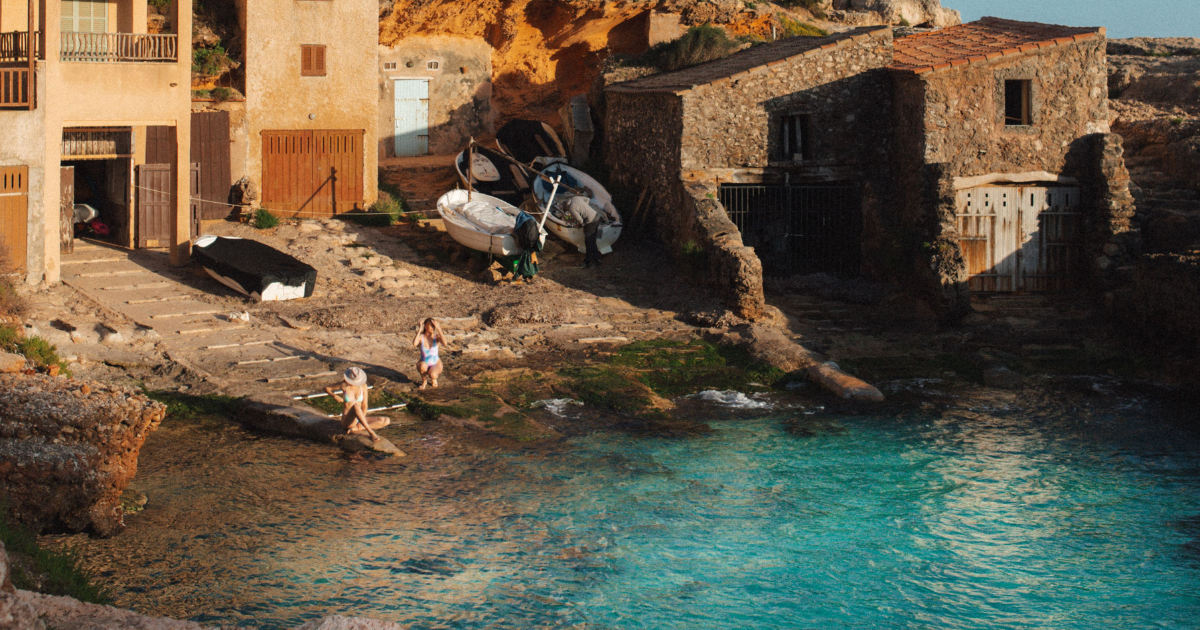
Choosing where to stay in Mallorca is the single most important decision you will make before booking. Not which villa has the nicest pool. Not whether to fly direct. Not even when to go. Where you base yourself will define the landscape you wake up to, the beaches you can reach in ten minutes, the restaurants within walking distance, and the pace of your whole holiday.
Mallorca is larger and more varied than most visitors expect. The drive from Palma to the northeastern tip of the Formentor peninsula takes over an hour on a clear day — longer in summer, when the mountain roads fill with cyclists and campervans. A villa in Deià and a villa near Alcúdia might both be “in Mallorca,” but they are, in every meaningful sense, two different holidays.
This guide is designed to help you choose yours.
We have broken the island into six distinct areas, each with its own character, landscape, and strengths. For each one, we will tell you who it suits best, what to expect, which beaches are within reach, and what kind of villa experience the area offers. We will not oversell any of them — every area has trade-offs, and knowing those honestly is what makes the difference between a good holiday and an exceptional one.
Why the Area You Choose in Mallorca Matters More Than the Villa Itself
Before diving into the regions, it is worth understanding a few things about how the island works in practice.
Mallorca is not small. At around 3,640 square kilometres, it is larger than many European islands people assume to be comparable. The Serra de Tramuntana mountain range runs the entire northwest spine of the island, and those winding mountain roads — beautiful as they are — add meaningful time to journeys. A villa “near Sóller” and a beach “near Alcúdia” might look close on a map and be 75 minutes apart by car.
Villa type varies dramatically by area. The northwest is dominated by traditional stone fincas — thick-walled farmhouses with terraced gardens, olive groves, and mountain views. The north offers larger, more open estate properties close to the sea. The southwest tends toward sleek contemporary architecture with clean Mediterranean lines. The east coast has some of the island’s most spacious rural properties. The interior is all about authentic, historic farmhouses in agricultural landscapes. Knowing which type suits your group is part of choosing your area.
The island has two completely different coasts. The northwest coastline — dramatic cliffs, pine forests, turquoise inlets accessible only on foot or by boat — bears no resemblance to the wide sandy bays of the north. Neither is better. They are simply different holidays.
Proximity to Palma matters more than people think. Palma is genuinely one of Europe’s great small cities — for a day’s culture, a Michelin-starred dinner, or a morning at the market. If your villa is in the north or east, Palma becomes a considered day trip. If you are based in the southwest, it is twenty minutes away.
With all of that in mind, here is where to stay in Mallorca based on who you are and what you are looking for.
North Mallorca: Pollença & Alcúdia — Best for Families
If you are travelling with children — whether toddlers, teenagers, or both — the north of Mallorca is the most reliably satisfying choice on the island.
The bay of Alcúdia and the bay of Pollença form two enormous, gently curving stretches of coastline, each backed by pine trees and shallow, calm, turquoise water. These are not the rugged coves of the northwest, where a swim requires a hike and the seabed is rocky. These are real sandy beaches, shallow enough for children to wade far out, warm enough from June through October, and broad enough that even in peak July and August they absorb crowds without feeling overrun.
The towns themselves are part of the appeal. Pollença is one of the most beautiful towns on the island — a honey-coloured cluster of stone buildings climbing a hillside, anchored by a Sunday market that has been running since the 13th century. The Calvary Steps, 365 of them, lead to a hilltop chapel with views over the valley; even the youngest visitors will scramble up at least half of them.
Alcúdia old town is walled, medieval, and compact — exactly the kind of place where an afternoon ambles into early evening at a café terrace without anyone noticing. The resort of Port d’Alcúdia, adjacent, offers pragmatic family conveniences: a waterpark, watersports hire, and a range of restaurants suited to varied appetites and bedtimes.
At the northern tip, Cap de Formentor rewards the drive with one of the most dramatic viewpoints in the entire Mediterranean. Go early in the morning to beat the summer crowds, drive as far as the lighthouse, and return via the beach at Platja de Formentor — a long, pine-fringed stretch of sand and flat calm water that consistently ranks among Europe’s finest.
The beaches within easy reach:
– Playa de Muro — 7 km of clean, shallow sandy beach; the best family beach on the island
– Port de Pollença beach — calmer, less crowded, excellent for paddleboarding
– Cala Sant Vicenç — a cluster of four small, sheltered coves, quieter and more intimate
– Platja de Formentor — pine-backed, beautiful, worth the early-morning drive
Who stays here: Families with young children. Multi-generational groups who need diverse beach options. Those on their first visit to Mallorca who want reliability over adventure. Anyone who wants to base themselves in a genuinely beautiful town — Pollença in particular — rather than a resort.
The honest trade-off: The north does not have the dramatic mountain scenery of the northwest or the hidden-cove romance of the east coast. But for a holiday that actually works — beaches that are safe and swimmable, towns with soul, villas with space — the north is consistently excellent.
A villa to consider in North Mallorca: Torre de Can Peroia
Set in Alcúdia, Torre de Can Peroia is a luxury villa sleeping up to ten guests — comfortably sized for a large family or two families travelling together. It comes with a private pool, a jacuzzi, and a sauna, and sits within easy reach of the island’s finest northern beaches. After a day at Playa de Muro or Platja de Formentor, a late afternoon in the sauna and an evening around the pool is, frankly, exactly what a north Mallorca villa should feel like.
Northwest Mallorca: Deià, Sóller & Valldemossa — Best for Couples & Culture Seekers
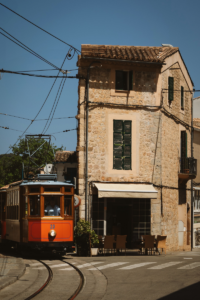
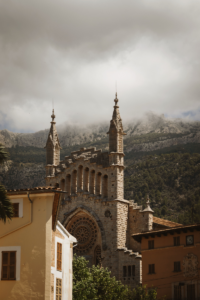
There is a reason that Robert Graves chose Deià in 1929 and never really left. That Michael Douglas has had a home in the northwest for decades. That the village of Valldemossa is, per square kilometre, one of the most photographed places in Spain.
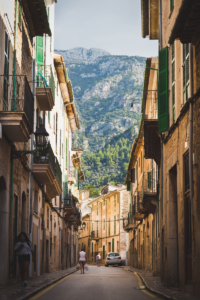
The northwest of Mallorca — the stretch of coastline and mountain running from Valldemossa through Deià to Sóller — is extraordinarily beautiful. The Serra de Tramuntana mountains, a UNESCO World Heritage landscape, drop almost vertically into the Mediterranean. The villages are stone-built, flower-hung, and intimate. The roads wind in ways that delight car drivers and test bus passengers. The light in the late afternoon, falling across the terraced olive groves, is the light that has made painters want to stay.
A villa in this part of Mallorca offers something qualitatively different from a resort-adjacent property: a sense of being in a landscape, not merely near it. You are waking up inside a UNESCO World Heritage Site. The mountains are the garden.
Deià is the cultural heartbeat of the northwest — a tiny village with a remarkable concentration of good restaurants, an art gallery, a thriving literary history, and a beach (Cala Deià) that requires a steep walk to reach and rewards it with absolute seclusion. It is romantic, it is quiet after dark, and it is one of the great intimate retreats in Europe.
Sóller is more liveable and more practical — a proper town with a weekly market, an excellent selection of restaurants, and the orange-and-lemon groves for which the Sóller valley has been famous for a century. The vintage tram that runs from Sóller down to Port de Sóller is one of those genuinely charming local details that still surprises visitors.
Valldemossa is the most visited of the three, partly because of its association with Chopin and George Sand, and partly because it is genuinely beautiful — a hilltop village of pale stone buildings with cobbled streets and a grand Carthusian monastery at its centre.
Dining from a northwest villa base: The northwest punches well above its weight on food. Bens d’Avall, between Sóller and Deià, is a long-standing institution with terrace views over the sea. Ca’n Costa in Fornalutx serves some of the best traditional Mallorcan food on the island. In Deià, the restaurant at La Residencia remains excellent.
The beaches within reach: Cala Deià, Cala Tuent (accessible via a mountain road — worth it for the sense of arrival), and the port beaches around Sóller. The northwest is not a beach holiday in the traditional sense. The swimming is beautiful, but it requires commitment: hikes, boats, or steep paths. This is part of the appeal for many — the beaches feel earned.
Who stays here: Couples on a romantic retreat. Culture-focused travellers — writers, artists, architects. Those returning to Mallorca for the third or fourth time, ready to move beyond the main resorts. Anyone who has read Graves, watched the light from the terrace, and already knows this is where they want to be.
The honest trade-off: The northwest is not practical for young families. The roads are slow and winding. The beaches require effort. Village restaurants suit adult tastes, adult hours, and adult patience. If you have children under ten, you will have a better holiday in the north. If you do not, this is one of the most beautiful places in Europe to spend a week.
A villa to consider in Northwest Mallorca: Finca Sa Frontera
Positioned at the heart of the Sóller valley, Finca Sa Frontera is a rustic rural finca sleeping six — exactly the right size for a small group or couple who want the whole property to themselves without rattling around in something too large. The saltwater pool, set against the mountain landscape, makes the daily rhythm simple: morning coffee in the valley, pool in the afternoon, Sóller old town in the evening. It is the northwest at its most honest.
Southwest Mallorca: Port d’Andratx & Calvià — Best for Luxury Seekers & the Sea
The southwest of Mallorca has a different energy from the rest of the island. The landscape is still Mediterranean, still beautiful — limestone hills, pine forests, rocky coastline — but overlaid with a layer of international sophistication that you do not find in the north or the interior. This is where the yachts are moored. Where the architecture tends toward clean contemporary lines and infinity pools facing the open sea. Where Palma is close enough for dinner and far enough away not to intrude.
Port d’Andratx is the anchor of the southwest — a genuine working fishing harbour that has evolved, over decades, into one of the most desirable anchorages in the western Mediterranean. The waterfront is lined with good restaurants; the harbour fills in summer with a level of yacht traffic that reminds you this corner of Mallorca has an international following that pre-dates Instagram by quite some time.
The Calvià municipality covers a wide arc of coastline that includes Santa Ponsa, Camp de Mar, and the rocky inlets near Paguera. The area rewards those who take the time to find its private positions: clifftop properties with direct sea access, contemporary houses with uninterrupted views of the water, and a level of architectural ambition that reflects the premium the southwest commands.
Proximity to Palma is one of the southwest’s underrated advantages. The airport and the city are 20–30 minutes away by car. For groups arriving on different days, or for those who want an evening in Palma’s old town without a long drive back, the southwest’s western position makes logistics genuinely easy.
The coastline: The southwest coast has dramatic cliff scenery, punctuated by small accessible coves. Cala d’Egos, Sant Elm beach, and the beaches near Camp de Mar are all within easy driving distance. For boat hire — one of the best ways to explore the smaller coves — Port d’Andratx is a natural starting point.
Who stays here: Couples and groups for whom the quality of the villa itself, the views, and the level of finish are the primary considerations. Those who want proximity to Palma for dining and culture. Boat enthusiasts. Guests combining their stay with a sailing trip or yacht charter.
The honest trade-off: The southwest is the most expensive corner of the island for villa rental. The family beaches are not as good as the north. The trade-off is pure quality: consistently outstanding properties, consistently excellent sea views, consistently close to everything Palma offers.
A villa to consider in Southwest Mallorca: Son Polvell
Villa Son Polvell is a private estate in Andratx, sitting on 12,000 square metres of grounds with a saltwater pool and views over the Serra de Tramuntana. Close to Port d’Andratx and all that the southwest offers — the marina, the cliff walks, the coast road — yet genuinely private in the way that only a property with that amount of land around it can be. This is the southwest at its best: scale, seclusion, and the sea in the distance.
East Coast Mallorca: Cala d’Or & Felanitx — Mallorca’s Best-Kept Secret for Groups
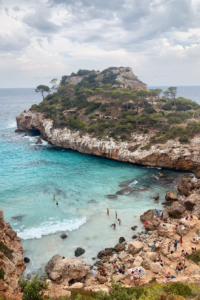
Mention the east coast of Mallorca to most visitors and you will get a slight pause — it is not the part of the island that gets written about in Sunday supplements. The northwest gets the features. The north gets the family bookings. The east, quietly, gets the guests who have done their research.
This is Mallorca at its most unhurried: a long arc of rocky coastline punctuated by small sandy coves, backed by agricultural land and scattered stone villages. The east coast is where the island’s most generously proportioned rural villas tend to be — sprawling finca estates with multiple bedrooms, expansive grounds, and private pools that can accommodate large groups in genuine comfort.
Cala d’Or is the east coast’s most established resort — a low-rise, relatively refined cluster of small marinas and sandy inlets that avoids the scale and noise of the north coast resorts while still offering good restaurants, watersports facilities, and a navigable high street. The coves immediately around it — Cala Gran, Cala Ferrera, Cala Mondrago — are genuinely lovely.
Felanitx and the surrounding countryside represent the east coast’s agricultural heart — almond groves, dry stone walls, isolated fincas, and the particular stillness of a Mallorcan landscape in summer. This is the island at its most local and most unhurried.
The secret coves: This is where the east coast genuinely excels. Cala Varques, south of Porto Cristo, is reached by a dirt track and a short walk — a limestone-framed arc of sand and astonishingly clear water, with no facilities and, in the shoulder season, almost no people. Cala Estreta, further north near Artà, sits within a nature reserve and requires a 45-minute walk through pine forest to reach. The effort keeps it exceptional.
Coves del Drach, near Porto Cristo, deserves a half-day from any east coast villa base: one of the world’s largest underground lake systems, with a classical music concert performed by musicians floating on boats across a subterranean lake. Theatrical, slightly surreal, and genuinely memorable.
Who stays here: Groups. Large families. Anyone who has struggled to find a villa that genuinely sleeps ten or twelve without feeling cramped. Those who value privacy and space over dramatic scenery. Guests who want easy access to hidden coves without competing for them.
The honest trade-off: The east coast lacks the visual impact of the northwest. If the landscape itself is part of what you are paying for, you will find more of it elsewhere. If you want the best-value space per person, reliable access to quiet beaches, and a genuinely unhurried pace, the east coast consistently delivers.
A villa to consider on the East Coast: Villa S’Hort D’Or
A traditional Mallorcan finca in Felanitx, Villa S’Hort D’Or offers exactly what the east coast does best: authentic character, generous space, and the quiet that the island’s more touristed corners make increasingly rare. Felanitx puts you within easy reach of Cala Mondrago and the southern coves, with Cala d’Or’s restaurants a short drive away and the feeling of being properly embedded in a working Mallorcan landscape.
Central Mallorca: Consell, Binissalem & the Interior — For Those Who Want the Real Island
Most visitors to Mallorca never see the interior. They fly in, drive to the coast, and spend a week oriented entirely toward the sea. Which means that the central plain — the Pla de Mallorca — remains, despite sitting at the geographical heart of a massively touristed island, genuinely quiet.
The interior of Mallorca is an agricultural landscape of almond trees, carob groves, wheat fields, and vineyards. The villages — Binissalem, Alaró, Consell, Santa Maria, Sineu — are lived in and local, with weekly markets that serve the island’s residents rather than its visitors, and restaurants that have no particular interest in adapting their menus for tourists. The stone houses are wide, low, and old.
Binissalem is the wine capital of Mallorca — home to the island’s most established Denominació d’Origen wines, including the distinctive Manto Negro red and the aromatic Prensal Blanc white. Several of the island’s best bodegas are within cycling distance: Bodega Macià Batle and José L. Ferrer are both worth visiting for tours and tastings.
Every September, Binissalem hosts the Festes de la Verema — three weeks of harvest festival centred around the grape harvest, with wine, music, street food, and the ritual grape battle that has been part of the village’s calendar for generations. Staying in a central Mallorca villa in September and being able to walk to the festival is one of those local experiences that no hotel can replicate.
Sineu, at the precise geographical centre of the island, has the largest weekly market in Mallorca — held every Wednesday morning and occupying most of the old town’s streets. It is a proper agricultural market: livestock, vegetables, fruit, local cheesemakers, and ceramics alongside the tourist goods that now occupy one corner.
The finca experience: The villas and fincas of the central interior are some of the most architecturally authentic on the island — centuries-old farmhouses converted with care, featuring thick stone walls that keep the interior cool in summer, traditional Mallorcan-tiled floors, and the kind of quiet that coastal properties, even the most private, rarely achieve.
Who stays here: Couples and groups who have been to Mallorca before and want to experience something beyond the coast. Wine enthusiasts. Cyclists — the central plain and the roads leading into the Tramuntana foothills offer some of the island’s most satisfying cycling on relatively gentle terrain. Those who actively value quiet over convenience.
The honest trade-off: The interior is not a beach holiday. The nearest good beaches are 25–40 minutes away by car. The interior is at its very best in spring (March–May, for the almond blossom) and autumn (September–October, for the harvest season). In high summer, choose a property with good shade and air conditioning — a stone finca without it can be warm at midday.
A villa to consider in Central Mallorca: Villa Bidaluxe
Villa Bidaluxe is set in Consell, a quiet village in the Mallorcan interior sitting between Binissalem’s vineyards and the foothills of the Tramuntana. A detached villa with a private pool, garden, and air conditioning — and the coast closer than you might expect. This is a property that gives you the authentic character of the central island without sacrificing comfort: a combination that is harder to find here than on the coasts, and all the more rewarding when you do.
Palma & Surroundings — The Urban Base with Island Access
Not everyone arrives in Mallorca looking for a quiet hillside retreat. Some groups want the city — the cathedral, the old town, the markets, the restaurants, the late evenings over a Mallorcan vermouth in a bar that has been pouring drinks since 1920. Palma can offer all of this, and a private villa on its outskirts gives you an uncommon combination: genuinely urban culture and a private pool.
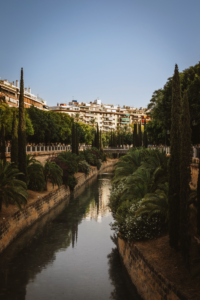
Palma de Mallorca is a city that consistently surprises visitors who arrive expecting a resort capital. The Gothic cathedral — La Seu — is one of the great ecclesiastical buildings in the Mediterranean, and the view from the waterfront, framed by the city walls and reflected in the moat gardens, is remarkable. The old town is a proper tangle of medieval streets, containing some of the island’s best galleries, independent shops, and restaurants in roughly equal proportion.
For villa guests: Staying in or immediately around Palma means a different kind of flexibility. The airport is fifteen minutes away. The motorway network radiates from the city, making day trips to the north (Pollença is under an hour), the east (Manacor is 45 minutes), or the northwest (Sóller is 30 minutes via the tunnel) all viable from a single base. This is a genuine advantage for groups who want variety — a different beach each day, a cultural day in Palma on another — without the long drives that a more peripheral villa base sometimes demands.
The coastal areas around Palma: Cala Major, Illetes, and Portals Nous, on the western edge of Palma, have excellent beaches within 15–20 minutes of the city. Portals Nous in particular — with Puerto Portals marina, several good restaurants, and a beach that does not feel like a resort — is a consistently pleasant day trip from a Palma-area villa base.
Markets and mornings: The Mercat de l’Olivar, Palma’s covered market, is one of the best food markets on the island — excellent for a private chef shopping list, or simply for spending an hour navigating the fish and cheese counters. Most things worth seeing in Palma are walkable from its centre.
Who stays here: Groups or couples for whom the island’s culture and food scene are as important as the beach. Those combining a Mallorca villa stay with meetings or events in the city. Anyone arriving on different days and needing airport proximity. Guests who want a genuinely urban holiday with villa privacy.
The honest trade-off: Palma and its immediate surroundings are busy in summer. If you want the remoteness of the Tramuntana or the east coast, a city-adjacent villa is not the right choice. For the best swimming, you will still be driving.
A villa to consider in Palma: Villa Tolomei
Villa Tolomei is a private villa in Palma de Mallorca, combining the privacy of a self-contained property with everything the capital has to offer within a short distance. For guests who want to arrive and immediately have the city at hand — La Seu in the morning, the Mercat de l’Olivar before lunch, a drive to Illetes beach in the afternoon — it is the Palma villa option in the 5StarsHome collection.
Which Area of Mallorca Is Right for You? A Quick-Decision Guide
Still deciding? Here is the short version.
| Your group | Best area | Second choice |
|---|---|---|
| Families with young children | North — Pollença & Alcúdia | East coast |
| Romantic couple retreat | Northwest — Deià & Sóller | Southwest |
| Large group, big villa needed | East coast — Felanitx & Cala d’Or | North |
| Luxury-first, sea-view villa | Southwest — Port d’Andratx | Northwest |
| Culture, slow travel, authenticity | Central — Consell & Binissalem | Northwest |
| City access + villa privacy | Palma & surroundings | Southwest |
| Multigenerational family | North — Pollença & Alcúdia | East coast |
| Hikers and cyclists | Northwest Tramuntana | Central interior |
| Wine and gastronomy focus | Central — Binissalem | Northwest |
| First visit to Mallorca | North or Palma area | Southwest |
Frequently Asked Questions: Where to Stay in Mallorca
Is it better to stay in the north or south of Mallorca?
For most first-time visitors, the north of Mallorca — around Pollença and Alcúdia — offers the most reliable experience: excellent sandy beaches, beautiful historic towns, easy day trips, and a wide choice of villa sizes and styles. The “south” covers a large area and varies significantly; the southwest (Port d’Andratx) is sophisticated and polished, while areas like Palma Nova and Magaluf in the southwest are more resort-oriented. For families, the north is consistently the strongest choice. For couples and those prioritising luxury, the northwest or southwest often wins.
Which area of Mallorca is best for families with young children?
North Mallorca — specifically the areas around Pollença, Alcúdia, and Playa de Muro — is the island’s best family zone by some distance. The beaches are shallow, sandy, and calm; the towns have good provisions and walkable centres; and the villa choice at this end of the island is excellent. Look for a property that sleeps your whole group comfortably and has pool safety features if you are travelling with toddlers.
Where in Mallorca is the most peaceful for a private villa stay?
The central interior — around Consell, Binissalem, and the Pla de Mallorca — is the quietest part of the island, with genuinely rural finca properties in agricultural landscapes well away from resort traffic. The east coast is also substantially quieter than the north or northwest in peak season. For peace combined with dramatic natural beauty, a villa in the Sóller valley or near Deià in the northwest offers seclusion without isolation.
Should I stay near Palma or further out in Mallorca?
It depends on your priorities. Staying near Palma gives you excellent airport access, city culture within minutes, and central positioning for day trips across the island. Staying further out — in the north, northwest, or east — gives you a stronger sense of place and often more dramatic landscapes. Many guests find that the 45–60 minutes from the north to Palma for a day visit is perfectly manageable; the drive back through the island in the evening is part of the experience.
What is the best area of Mallorca for a villa with sea views?
For dramatic, elevated sea views — the kind that make you stand at the terrace wall and simply stare — the northwest (Deià, Sóller, and the Tramuntana coastline) is unmatched. The mountains meet the sea in a way that creates genuinely spectacular villa positions. For contemporary properties with direct sea or pool-to-sea views, the southwest around Port d’Andratx is excellent.
When is the best time to book a villa in Mallorca?
For peak summer weeks (late July through August), the best properties are booked by January or February at the latest. For June and early July, booking by March is advisable. The shoulder seasons — May to mid-June and September through October — offer better availability, often the best weather of the year, and a version of the island that the peak-season crowd largely misses. September in particular is exceptional: the sea is at its warmest, the landscape is golden, and the roads are navigable again.
One Island, Many Holidays
Mallorca rewards the guest who takes the time to understand it properly. The traveller who arrives expecting a single Mediterranean island and discovers instead six genuinely distinct landscapes — mountain, coast, harbour, agricultural plain, city, and cove — is the one who leaves already planning a return.
Whichever area you choose, the island will give you the fundamentals generously: warmth, water, food that is genuinely rooted in the land, and a scale of beauty that is, by any measure, remarkable. The area choice is simply about which version of that beauty you want to be closest to.
If you know your answer, we have the villas. If you are still deciding, write to us at bookings@5starshome.com — we are happy to help you match the right area to your group.
Browse all 5StarsHome villas in Mallorca →